Article about ISP's
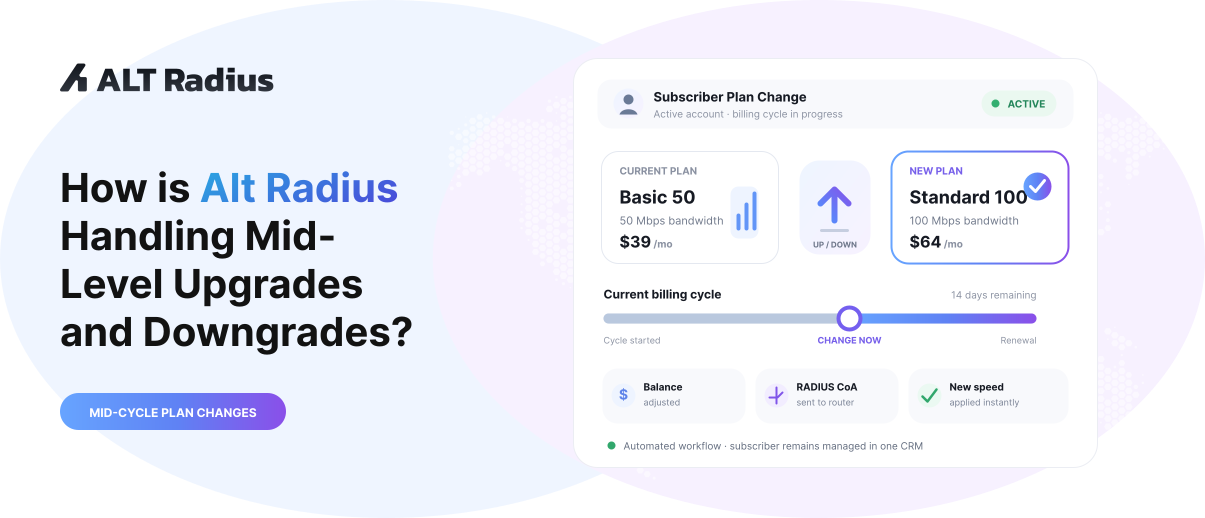
Customers do not wait until the end of a billing cycle to change their internet plan. They may want to change it while their current plan is continued. They may need to increase their internet speed. But customers' needs vary. Not every customer wants to increase their internet speed. They may want to reduce it to lower their monthly bill.
In short, customers' decisions about their internet packages change with time. Handling all this requires so many calculations and time. It may take more time and effort if an ISP has around 1000 to 10K subscribed users per month. In this scenario, manual handling is not possible.
Alt Radius solves this problem. It handles these mid cycle plan changes directly within the software. The billing adjustments and clawbacks are all handled with precision. So, our customers don’t need to worry about it.
However, you may be wondering how this process carries on or how it is possible to handle such calculations with precision. Let’s discuss it in detail here. But before going further, we need to know about Mid level upgrades and downgrades.
What are Mid Level Upgrades and Downgrades?
Mid Level upgrades and downgrades refer to changes in monthly internet plans to a different tier without switching providers. These adjustments balance your monthly budget against your household's daily speed demands.
For example, a customer buys an entry level monthly internet plan for $20. The customer wants to take a middle tier plan. They request it in the middle of the month (after 15 days of initial purchase). The middle tier plan is $30.
Now they have already paid $20 for the entry level plan. They only need to pay $5 to upgrade to the middle tier plan (assuming a daily pro-rata calculation).
Let’s suppose a customer wants to go from a higher tier plan to a lower tier plan in the middle of the month (after 15 days of initial purchase). The high tier plan is $45 while the lower tier plan is $20. They will be subscribed to the entry level plan, and $12.50 will be credited to their account.
The calculations are not as simple as it seems. Sometimes a customer requests an upgrade or downgrade after 12 or 20th day of initial purchase; the software does all the calculations and lets them know how much they need to pay or how much needs to be credited to their account.
How Does Alt Radius Handle Mid-Cycle Plan Changes?
Since everything is handled by software, there’s no chance of errors. Let’s understand how Alt Radius handles mid level upgrades and downgrades with precision.
Pro Rated Billing Adjustments
When a customer upgrades or downgrades in the middle of a billing cycle, Alt Radius calculates the adjustment on a pro-ration basis. The customer is charged only for the applicable difference for the remaining days of the current cycle rather than being charged for an entire new plan.
This keeps the billing fair and eliminates the need for manual calculations by the ISP's billing team.
Upgrades During an Active Billing Cycle
If a customer wants more bandwidth or additional services, they should not have to wait until the next billing date. Customers just need to request it. Alt Radius CRM processes the mid-cycle upgrade and applies the relevant billing adjustment for the remaining period.
This allows the customer to start using the upgraded plan when the change is made while keeping the billing calculation aligned with the actual upgrade date.
Downgrades and Service Changes
The same process applies when a customer wants to move to a lower package or cancel a service. Alt Radius manages the subscription change and the corresponding billing adjustment within the CRM. This helps ISPs avoid separate manual calculations across different systems.
When a customer purchases a move from a high tier plan to lower tier plan, the software will automatically provide them with an accurate balance. It will request the relevant person and if the individual doesn’t have a balance at that time, it will credit it into their account.
The software will take the amount that the customer requires and credit it to the customer’s account. This is especially useful for ISPs using a multi-tier user structure, where customers may be managed through different partners or agents.
Alt Radius helps keep these customer and service changes organized within the same CRM. Hence it becomes easier to manage plan changes across different levels of the user hierarchy.
Credit Notes for Downgrades
A downgrade can leave the customer with an unused amount from their previous plan. Alt Radius can handle this adjustment through credit notes. This ensures that the customer's account reflects the appropriate credit.
The credit can then be accounted for according to the ISP's billing process, while the transaction remains properly recorded in the system. This helps the ISP know how much is credited to customers’ accounts.
Credit notes provide ISPs with all the details and calculations so there will not be any issues regarding payments or clawbacks.
0% Disconnectivity During Plan Changes
For an ISP, a plan change should not result in the customer losing internet access while the billing system updates the account. Alt Radius is designed to handle plan changes with 0% disconnectivity, allowing the customer to move between plans without an unnecessary service interruption.
This is particularly useful when customers upgrade or downgrade during an active billing cycle. The CRM handles the plan and billing changes while maintaining service continuity.
Automatic Network Updates
Automatic network updates refer to automatic changes to customers’ internet service settings upon plan change. ISP employee doesn’t need to manually change the customer’s bandwidth or network configuration. The system communicates the new plan information to the network.
For example, when a customer wants to upgrade to a higher speed package, they need to send a request through Alt Radius ISP CRM. Similarly, when the customer wants to downgrade, they again need to request that with the reason.
Alt Radius uses RADIUS and Change of Authorization (CoA) capabilities to help apply these plan changes to the customer's active session. This can reduce the need for manual billing calculations and help keep the customer's billing information and service configuration aligned.
Managing Plan Changes in the ISP CRM
Alt Radius brings the entire mid-cycle change process into one system. From upgrades and downgrades to pro-rated billing, credit notes, cancellation, and service continuity, the ISP can manage the customer's account without relying on separate manual processes.
For ISPs, this means fewer billing errors, less administrative work and a smoother experience for customers who need to change their internet plan before the current billing cycle ends.
Why Automate Mid-Cycle Plan Changes?
Mid cycle plan changes can’t be handled manually. It can create extra work for ISP teams. Staff update the customer’s subscription. But calculating the billing adjustment and applying new service settings manually for each customer is difficult. Automation helps with that
Automation reduces repetitive work. When a customer changes their plan, the system can calculate the applicable pro-rated amount. The system also updates the subscription information and helps apply the corresponding network changes.
Automation can also help reduce the risk of calculation and data entry mistakes. The system automatically applies the same billing rules to different customers. Rule application depends on the plan change date and the remaining portion of the billing cycle.
This is helpful for customers and ISPs. Customers can request a different package during the active billing cycle. As ISPs are operating with a multitier user structure, they can manage plan changes across customers, partners and agents efficiently.
Final Thoughts
Mid cycle upgrades and downgrades are a normal part of managing an ISP’s subscriber base. However, it is difficult to manually process them while the customer base is growing. The challenge is not just changing the customer's package.
Accurate billing calculation and adjusting new plans is also challenging. Alt Radius helps ISPs automate these processes through its CRM and billing capabilities. The software precisely handles the plan change workflow.
In short, customers can smoothly change their internet plans before the next billing cycle. On the other hand, the automation reduces repetitive administrative work. They can now keep subscriber records, billing and network settings aligned.
FAQs
Does changing a plan affect the customer's existing billing history?
No. A plan change doesn’t require the ISP to discard the customer's previous billing records. The adjustment can be recorded against the existing account so the customer and ISP have a clear transaction history.
Can ISPs set different rules for different internet packages?
Yes. ISPs may have different pricing, billing periods and service rules for different packages. A CRM can apply the relevant configuration when processing a customer's plan change.
What happens if a customer changes their plan more than once in one billing cycle?
The system can process each eligible change based on the account's current subscription and applicable billing rules. This helps keep the customer's subscription and financial records synchronized even when multiple changes occur.
Can mid-cycle plan changes be managed for prepaid customers?
Yes, depending on the ISP's billing model and configuration. The system can apply the relevant account adjustment while keeping the customer's subscription information updated.
How does Alt Radius help prevent duplicate billing after a plan change?
By keeping the subscription and billing information within the same system, Alt Radius helps ensure that the customer's updated plan is reflected in the account. This reduces the need for employees to make the same change manually across multiple systems.
Can an ISP review a customer's previous plan after a plan change?
Yes. Maintaining account and transaction records allows ISP teams to review previous subscription activity when needed. This can be useful for billing queries, customer support, and account verification.
What if a customer requests a plan change but the billing team has not processed it yet?
The request can be handled according to the ISP's internal workflow and approval rules. Once the change is processed, the customer's subscription and applicable account adjustments can be updated accordingly.
Can plan changes be managed across multiple customer accounts?
Yes. A centralized ISP CRM makes it easier for teams to manage subscription changes across a large subscriber base without handling each account through separate spreadsheets or manual calculations.
Does Alt Radius support plan changes for customers managed by agents or partners?
Yes. Alt Radius is designed to support ISPs with multi-level customer structures, allowing subscription-related activities to be managed within the same CRM environment.
Can customers change plans without contacting the ISP every time?
That depends on how the ISP configures its customer portal and approval workflow. If self-service plan changes are enabled, customers may be able to submit their requests directly, while the ISP can manage the resulting account changes through the CRM.
How can ISPs verify that a plan change was applied correctly?
ISP staff can review the customer's subscription and account records after the change. Keeping these details in a centralized system makes it easier to verify that the intended package and associated account updates were applied.