Partner Receivable
Partner receivable is a page to manage and overview the money owed to partners. The branch has to recover it. The money was given issue on credit before payment at that time.
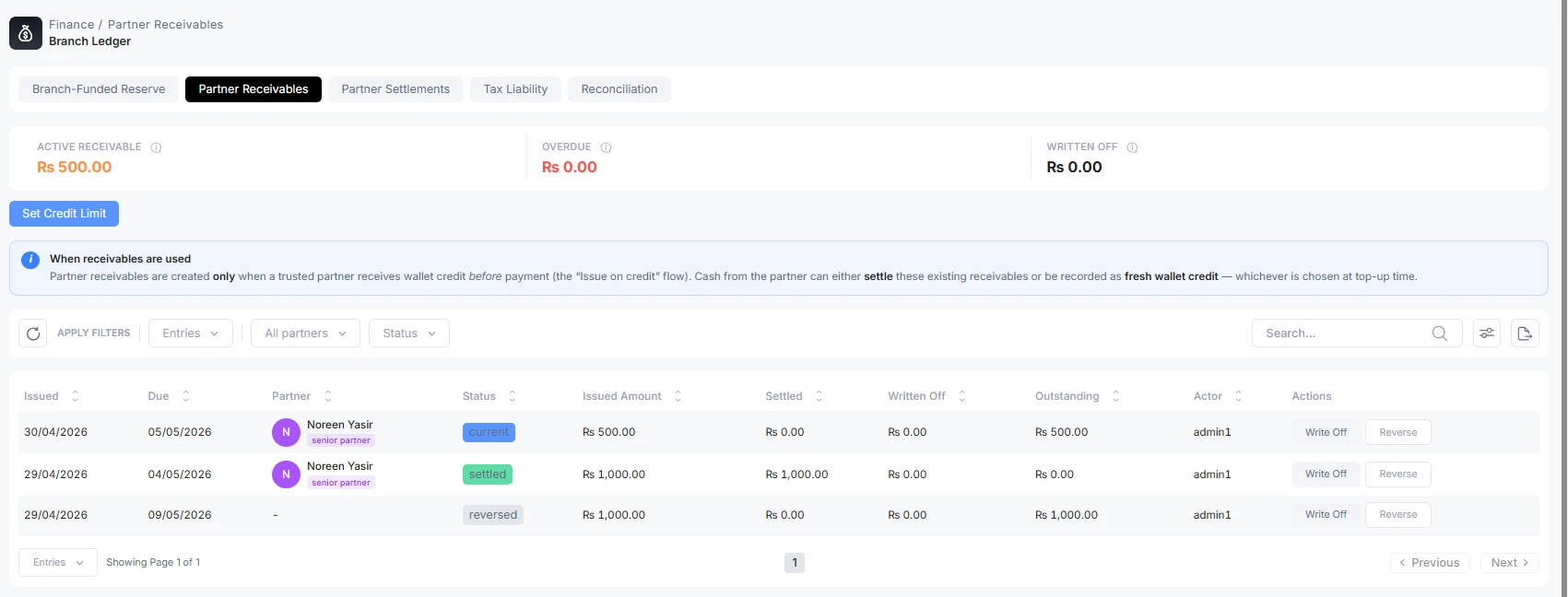
The overview shows
Active receivable: The total amount needed to be paid back to the branch
Overdue: Amount from receivable whose duration limit has passed
Write off: The unrecoverable amount/bad debt that can not be recovered
Set Partner Credit Limit
Credit limit is the amount a partner/senior partner/agent can borrow as credit on issue from the branch. Setting a Partner credit limit is a must before a branch can provide credit on issue.
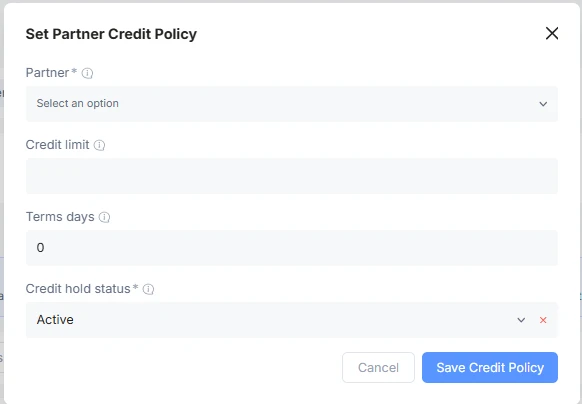
Partner: Choose from drop down list of senior partner/partner/agent
Credit limit: The amount set to be borrowed from the branch
Term days: The number of days the partner can pay the credited balance
Credit Hold status:
Credit Hold Status is used to control whether credit is allowed. It protects the branch from giving more credit when a partner or customer is already risky, overdue, suspended, or written off.
| Status | Meaning | What Happens |
| Active | Partner is trusted for credit | The branch can issue credit if the credit limit allows it |
| Hold | Credit is temporarily paused | The branch cannot issue more credit, but the partner can still pay old dues or top up with cash |
| Suspended | The partner credit facility is stopped | The branch cannot issue more credit |
| Written-off / Blacklist | Partner has serious unpaid or written-off debt | The branch cannot issue more credit |
Receivable Overview Explain
-
Issue date of receivable
-
Due date partner needs to return
-
Partner name
-
Status of receivable
-
Amount issued as receivable
-
Settled amount: the amount that is paid from current receivables
-
Write off: the amount sent to write off
-
Outstanding dues: the amount has to be paid
-
Actor: Admin name
-
Actions: two actions can be done here, reverse or write off (reverse means taking the balance back to the branch and write off as uncollectable (debt)
Filter Partner by Status
We have provided a filter to quickly find out various

| Status | Meaning |
|---|---|
| Current | Not paid overdue yet. |
| Overdue | The due date has passed. |
| Settled | Fully paid by the partner. |
| Written off | The remaining amount was written off (free-up) |
| Reversed | Original on-credit issuance was cleanly reversed. |
Filter by Partner Name
If the list of receivable partners is so long, we have provided a filter to search by name.

Settling Receivables
Use Top Up Partner Wallet > Settle receivable when the partner pays off old on-credit debt.
The system suggests paying the oldest receivables first. Finance staff can adjust allocation if needed.
Rules:
-
Allocation cannot exceed the payment amount.
-
Allocation cannot exceed the receivable outstanding amount.
-
Fully paid receivables become settled.
-
Excess payment can become a Wallet credit.
Write-Offs
Use a write-off when the branch decides the partner will not pay all or part of the receivable.
Example:
-
The partner owes $300.
-
The branch accepts $200 and writes off $100.
-
Receivable outstanding becomes $0.
A write-off does not claw back partner wallet credit already used. It records that the branch accepts the loss or adjustment according to policy.
Clean Reversal
A clean reversal is for mistakes caught early.
It should only be used when:
-
The receivable has no payments allocated.
-
No write-off was recorded.
-
The wallet credit has not been consumed.
-
The reversal is within the allowed reversal window.
If those conditions are not met, use a manual adjustment or write-off process instead of a clean reversal.
What To Check
-
Outstanding amount matches expectations.
-
Due dates are correct.
-
Overdue receivables appear in Finance Attention.
-
The partner wallet is not changed by settlement payments unless there is an excess.
-
Write-off does not create a hidden wallet debit.
Common Mistakes to Avoid
-
Using Add wallet credit when the partner is paying old receivables.
-
Issuing on-credit to a partner with no approved limit.
-
Writing off receivables without notes.
-
Reversing a receivable after the wallet credit was already consumed.